Evaluating your Retail RFID ROI is the first step to eliminating quiet margin killers. Imagine a customer walks into your retail boutique in SoHo or Beverly Hills. They are holding their phone, pointing at your Shopify store: “I’m looking for this specific silk dress in Medium. Your website says you have two left in this store.”
Your sales associate checks the rack. Nothing. They check the backroom. Nothing.
The customer leaves disappointed. Your brand just suffered a “Ghost Sale.” The system swore the item existed, but reality said otherwise.
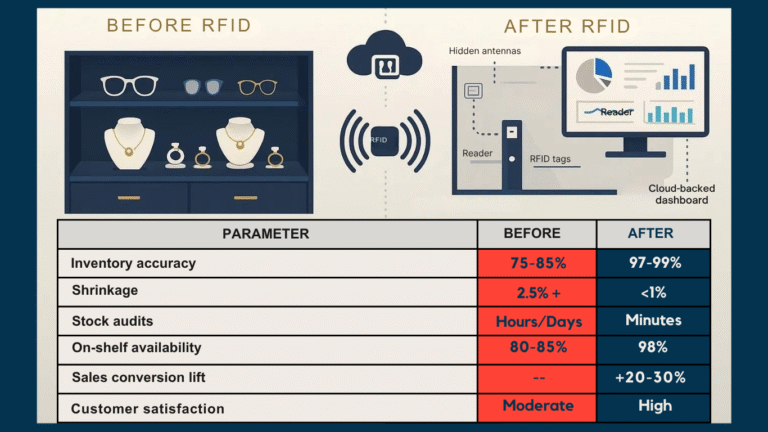
Most US apparel retailers operate at a shocking 60% to 65% inventory accuracy rate. That means nearly 4 out of 10 items on your digital dashboard are wrong. You are paying rent for floor space, paying wages for manual inventory counts, and losing up to 8% of your total revenue to items that simply aren’t where they should be.
When we talk about the Return on Investment (ROI) of Invento RFID (Hardware + Software), we aren’t just talking about buying tags and readers. We are talking about buying back your profit margins.
The Hidden Leaks: Where Your Money is Actually Going
Previous retail models treated technology as an experimental luxury. In 2026, understanding these financial metrics functions as an operational shield. When you implement a complete Invento RFID ecosystem, your financial recovery happens across three major fronts:
1. Shifting Labor Hours to Customer Experience
Traditional barcode auditing is an operational nightmare. It forces your staff to scan every single garment line-of-sight, item by item.
- The Reality Check: Invento’s automated RFID handheld readers process thousands of tags per second. A full-store stock count that used to take an entire weekend and three employees now takes 15 minutes for a single person.
- The ROI Impact: You instantly cut inventory labor costs and reallocate those paid hours to active selling on the retail floor.
2. Cutting Markdowns by 50%
Why do retailers run aggressive, margin-killing end-of-season clearances? Because they over-ordered “safety stock” to compensate for bad data. With Invento RFID bringing your accuracy up to 95%–99%, you only order what sells. Leaner stock means fewer markdowns and higher gross margins, and a much faster Retail RFID ROI.
3. Stopping Shrinkage in Its Tracks
Loss prevention isn’t just about security guards; it’s about absolute digital visibility. Item-level tracking creates a real-time audit trail. By knowing exactly when and where an item went missing, apparel stores routinely see a 50% reduction in shrinkage and theft losses, directly accelerating your Retail RFID ROI.
Stop Guessing. See Your Exact Payback Period.
Every retail network has unique variables: your store count, average item value, and annual revenue change the math. You shouldn’t rely on generic industry case studies to make an infrastructure decision.
We engineered a dynamic, retail-first tool so you can stop estimating and start knowing. By plugging in your actual operational numbers, our algorithm benchmarks your store against live market data to give you a conservative, bulletproof payback timeline. Most Invento clients see full capital recovery within 3 to 6 months.
To find your exact net savings and see how fast your business can scale, use our interactive tool below:

Moving From Strategy to Execution
The cost of doing nothing is no longer zero. Securing a strong Retail RFID ROI is essential for survival in modern apparel retail. Running a modern retail business with 60% data accuracy is costing you more in ghost stock and lost sales than the investment in a modern hardware and software solution.
Let our engineering team build a tailored financial case for your retail network.
- Schedule a Discovery Meeting
- Direct Contact: sales@inventorfid.com
Frequently Asked Questions
What is the main benefit of using Invento RFID for small and mid-size retailers?
Invento RFID offers significant advantages for small and mid-sized retailers by improving inventory accuracy, which eliminates costly instances of ghost sales. With an item-level accuracy rate of 95% to 99%, growing brands can effectively track merchandise across multiple locations, ensuring that customers always find exactly what they are looking for. This technology allows mid-market and independent businesses to optimize their stock levels, minimize shrinkage losses, and elevate the overall customer experience by reallocating labor from manual inventory counting to high-value customer service.
How does RFID help in reducing operational costs?
RFID technology streamlines inventory management, significantly cutting down the time and effort required for stock counts. Traditional manual audits are labor-intensive and time-consuming, often taking entire weekends. Invento’s automated handheld readers can scan thousands of items in moments, allowing retailers to minimize labor costs. This efficiency lets stores reassign employees from backroom tasks to customer-focused roles, enhancing sales and reducing operational overhead.
Can RFID technology actually improve sales numbers?
Yes, RFID technology directly drives sales growth by eliminating costly stockouts through real-time inventory visibility. When retailers achieve 99% accuracy, they can maintain optimal stock levels and meet customer demand without overordering or facing empty racks. By preventing stockouts on high-demand items and sizes, brands capture every single conversion opportunity, avoiding the missed revenue that ruins the shopping experience. Ultimately, ensuring reliable stock availability turns first-time shoppers into loyal customers, resulting in sustained sales growth and maximized gross margins.
What are the long-term financial returns of implementing RFID?
Long-term financial returns from implementing RFID can be substantial. Most retailers using Invento RFID report full capital recovery on their investment within 6 to 9 months. By enhancing inventory accuracy, reducing shrinkage, and reallocating labor, businesses can expect improved profit margins and overall financial performance. Besides direct sell-through increases, businesses often find additional savings in operational efficiencies that ripple through their financial statements.
How does RFID technology relate to loss prevention?
RFID technology enhances loss prevention measures through real-time tracking of items. With detailed visibility at the item level, retailers can monitor inventory movement and identify discrepancies quickly, reducing theft and shrinkage rates. The technology allows for immediate auditing, providing insights into when and where losses occur. Retailers have reported up to a 50% reduction in these losses, making RFID a critical asset for improving security measures and protecting profit margins.
What factors should be considered before transitioning to RFID?
Before transitioning to RFID, retailers should consider factors such as store size, inventory turnover rates, and existing technology infrastructure. Understanding the specific needs of your retail operation is crucial. It’s advisable to analyze the expected payback period and how RFID will enhance operational efficiency. Additionally, consulting with an RFID provider for tailored solutions and support during the implementation process can significantly mitigate risks associated with the transition.
Conclusion
Implementing Invento RFID transforms your retail operations by significantly enhancing inventory accuracy, reducing costly ghost sales, and reallocating labor towards improving customer experiences. With proven results delivering a strong Retail RFID ROI and a payback period of just 3 to 6 months, adopting this technology is a strategic investment into your profitability. Discover the difference accurate inventory can make for your bottom line by exploring our tailored solutions today. Don’t let outdated systems drain your resources; let us help you modernize your retail approach and maximize your returns.