The Multi-Billion-Dollar Challenge of Modern Retail Shrinkage
It was a chaotic Friday afternoon at a bustling mid-sized apparel boutique in downtown Manhattan. As the store faced typical weekend rushes, management realized the urgent need for modern RFID loss prevention. The store was packed, shelves were being cleared, and the sales team was stretched thin. Amid the rush, a group of coordinated shoplifters walked out the front doors with thousands of dollars worth of premium designer jackets. The traditional Electronic Article Surveillance (EAS) gates at the exit remained completely silent. Why? Because the shoplifters had lined their bags with aluminum foil—a classic tactic used to bypass old acoustic-magnetic systems.

By the time the store manager realized the inventory discrepancy during the end-of-month manual count, the revenue was already lost. This phenomenon is a textbook example of modern organized retail crime, a multi-billion-dollar crisis affecting both independent boutiques and expanding regional brands.
In today’s highly competitive retail market, protecting your margins is just as critical as driving sales. Traditional security systems are failing against sophisticated theft tactics, leaving businesses exposed to severe financial leaks. Fortunately, modern technology offers a definitive solution: item-level RFID loss prevention.
Beyond Traditional EAS: How Item-Level RFID Detection Works
For decades, retailers have relied on legacy EAS systems that operate on a simple, binary logic: either a tag is active, or it is not. If a tag passes the gate, an alarm sounds, but the system cannot identify what is leaving the store or how many items are involved. This lack of data leaves security teams completely in the dark.
A synchronized RFID theft detection solution changes the paradigm entirely by providing absolute data transparency at the exact moment an item leaves the premises.
Real-Time Item Visibility at Exits & Entrances
Unlike old systems, RFID loss prevention systems scan the unique Electronic Product Code (EPC) embedded in every single garment chip. This is the exact same foundational data structure used to power a brand’s Digital Product Passport (DPP) for end-to-end traceability and authentication. When an item passes through the tracking zone, the system instantly identifies the exact SKU, color, size, and style. This allows store managers to know precisely what inventory is targeted by shoplifters, transforming unidentifiable shrinkage into actionable digital data.
Differentiating Between Paid Merchandise and Stolen Goods
One of the biggest operational headaches for retail staff is the “false alarm”—a customer who paid for their clothes but triggers the alarm because the cashier forgot to detach or deactivate a legacy security tag. RFID technology eliminates this friction. By communicating directly with your Point of Sale (POS) system, the RFID software instantly knows if an item’s status is set to “Sold.” If a customer walks out with a paid item, the gates remain silent. If the status is “In Stock,” the alarm triggers instantly, confirming an active theft attempt.
The Invento RFID Edge: Tailored Loss Prevention Solutions
This is exactly where Invento RFID’s specialized Loss Prevention & Theft Detection solutions redefine store security. By seamlessly combining Electronic Article Surveillance (EAS) with real-time inventory tracking, Invento provides hardware and software options engineered to reduce retail shrinkage by 60% to 80% with no false alarms, all while drastically improving store aesthetics.
Retailers can choose from three discreet, partner-verified hardware systems tailored to their specific architectural needs, all powered by our high-performance Ultra-High Frequency (UHF) technology:
- InventoSafe (Overhead RFID Systems): Designed for retail stores, warehouses, and high-traffic entrances, this ceiling-mounted or wire-suspended master unit utilizes multiple beam and steering technology to minimize false alarms. It keeps store entrances completely free from obstacles, maintaining premium aesthetics while generating theft heatmaps and statistics to identify high-risk products.
- InventoMat (Floor-Based Detection): The ultimate discreet solution for luxury boutiques, apparel stores, and electronics warehouses. At an ultra-slim 0.4” thickness, these non-visible, weather-resistant floor antennas track items seamlessly between the backroom and the sales floor, featuring silent alarms to avoid customer disruption while keeping entrances wide open.
- InventoGate (RFID Discreet Pedestals): Perfect for high-traffic entrances, backdoors, and corridors. InventoGate features electronic beam steering to accurately differentiate between static and moving tags—avoiding 95% of false alarms through a continuous, lightning-fast detection field with plug-and-play installation.
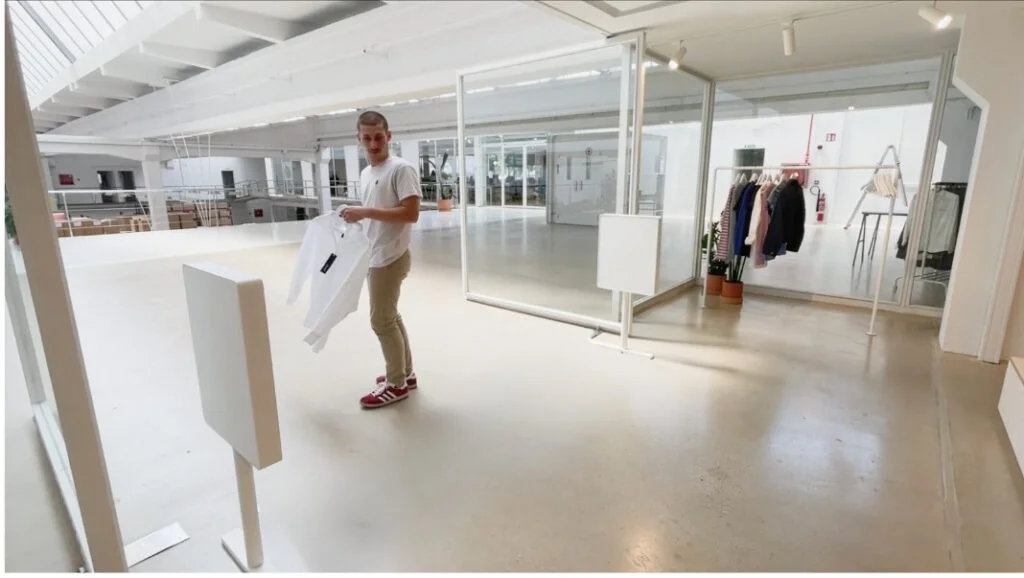
How the Invento Loss Prevention System Works:
- Smart Tagging: UHF RFID-enabled EAS labels are applied to each item (attached to hangtags or embedded directly into the product), ensuring merchandise stays damage-free while allowing easy try-ons.
- Automated Checkout Deactivation: As soon as a customer completes a purchase, the POS system automatically updates the item’s digital status, eliminating the risk of false alarms at the door.
- Exit Detection & Real-Time Sync: If an unpaid tag crosses the exit zone, the system triggers acoustic and visual alerts, instantly logging the specific stolen item IDs (SKU, size, color). This data automatically syncs with InventoCloud™ to generate theft statistics, adjust inventory levels in real time, and provide evidence for police reports.
SMBs and Mid-Market Retailers: Protecting High-Value Inventory
There is a common misconception that comprehensive RFID tech is a luxury reserved only for global enterprise chains. In reality, small and mid-sized retailers (SMBs) are often the hardest hit by theft, as they lack the massive capital reserves to absorb heavy inventory losses.
For a growing independent brand or a mid-market retailer managing multiple regional branches, losing a high-value display of premium merchandise can completely ruin the month’s profitability. Implementing an integrated Invento RFID loss prevention ecosystem allows smaller operations to scale safely, optimize their staff allocation, and gain the exact same technological safeguards used by global retail giants.
Data & Industry Insights: The True Cost of Shrinkage
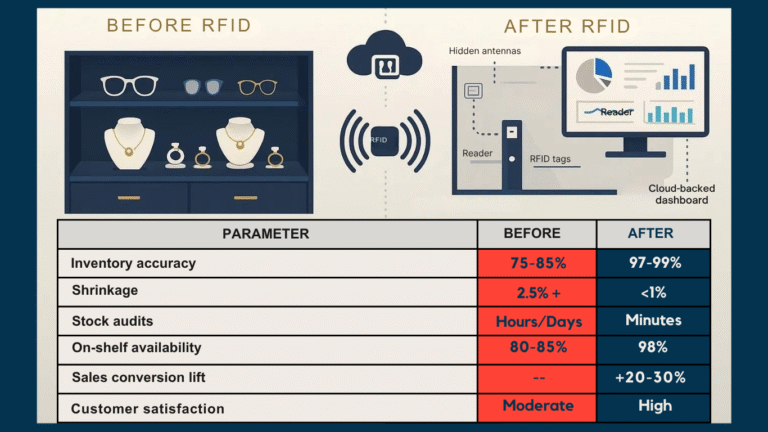
According to recent retail industry benchmarks, shrinkage accounts for an average loss of 1.6% to 2% of a retailer’s total revenue. While that might sound like a small percentage on paper, the compounding effect on your bottom line is devastating. For a mid-market retailer generating $5 million in annual sales, a 2% shrinkage rate translates to $100,000 completely wiped out every year.
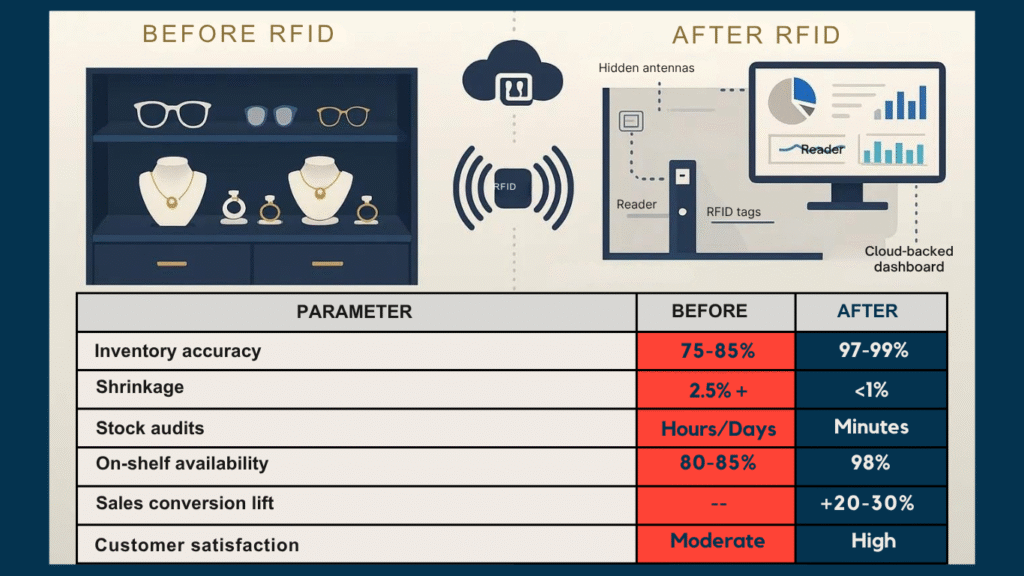
By upgrading to an item-level tracking ecosystem, retail businesses consistently reduce their overall shrinkage rates by 60% to 80%, instantly recovering thousands of dollars that flow directly back into net profits.
Curious Facts About Retail Theft
- The Booster Bag Phenomenon: Coordinated shoplifters frequently use “booster bags”—regular shopping bags lined with specialized layers of aluminum foil—to block the electromagnetic signals of old EAS gates. Modern RFID sensors, however, are significantly more resilient and can be paired with intelligent software that flags dense signal blockages instantly.
- The Friday Rush: Statistically, the vast majority of retail theft incidents occur between Friday afternoon and Sunday evening. Shoplifters deliberately leverage high-traffic weekend hours, knowing that store staff will be distracted by serving legitimate customers.
- Internal vs. External: While shoplifting dominates the news headlines, internal employee theft accounts for nearly a third of all retail shrinkage globally. RFID tracking deters internal theft by maintaining a strict, unalterable digital ledger of exactly when and where an item moved.
Don't let inventory shrinkage control your bottom line. Transitioning from legacy, reactive alarms to an elegant, data-driven UHF RFID ecosystem is the most effective way to scale your business safely.
At Invento RFID, we specialize in deploying cost-effective, seamless solutions tailored to your store’s architecture without disrupting your day-to-day operations.
Take the first step toward 99% inventory accuracy and zero false alarms today.
Book a Discovery Meeting & Get a Custom Quote here:
Frequently Asked Questions (FAQ)
Can RFID tags be tracked outside the retail store?
No. RFID loss prevention tags are passive, meaning they do not contain a battery or a continuous power source. They can only be read when passing directly through an active Invento RFID antenna field, such as the pedestals located at a store’s exit. Once a customer leaves the storefront, the tag cannot transmit data or track location.
How does RFID compare to traditional barcode scanning?
Traditional barcodes require a direct, line-of-sight physical scan for every single item, making theft detection at the door impossible. RFID tags use radio waves, allowing multiple tags to be scanned simultaneously from a distance without opening boxes or manually pointing a laser at a label.
Is it difficult to integrate loss prevention with our current inventory software?
Not with a modern ecosystem. Invento RFID’s solutions seamlessly bridge hardware components with your existing cloud inventory platforms and POS databases, updating your stock data automatically in real time.
How does Ultra-High Frequency (UHF) RFID differ from traditional security tags?
Traditional security tags operate on low frequencies and only trigger a simple chime without identifying the product. UHF RFID operates on high-speed frequency bands (860–960 MHz), allowing store sensors to read dozens of unique item tags per second from a distance, pinpointing the exact product type, size, and SKU being moved.
What happens if a customer buys an item? Will it trigger the exit pedestals?
No. When a transaction is completed at the Point of Sale (POS), the Invento RFID software instantly changes the item’s status in the cloud database from “In Stock” to “Sold.” When the customer exits the store with their paid merchandise, the UHF exit pedestals recognize the “Sold” status and allow the customer to pass without sounding an alarm.
Can RFID loss prevention systems detect organized retail crime (ORC) tactics like booster bags?
Yes. While traditional acoustic-magnetic gates fail when shoplifters use foil-lined “booster bags,” modern UHF RFID sensors and intelligent software algorithms detect signal disruptions and unauthorized mass movements, alerting security personnel instantly before the perpetrators leave the store.
Does installing RFID exit pedestals require disrupting store operations?
Not at all. Modern UHF RFID loss prevention pedestals are designed for rapid deployment. They integrate seamlessly with your existing store architecture and connect via cloud network protocols to your current inventory database without requiring extensive rewiring or store downtime.
Will RFID technology reduce internal employee theft as well as shoplifting?
Yes. Internal shrinkage accounts for nearly a third of all retail losses. Because UHF RFID maintains an unalterable digital log of every item’s movement from the stockroom to the sales floor and the exit gates, it creates full operational accountability, significantly deterring internal theft.
Conclusion
In the modern retail landscape, relying on outdated security methods is a liability that growing brands can no longer afford. Protecting your inventory requires a shift from passive, blind monitoring to active, data-driven visibility. By adopting item-level RFID loss prevention, small and mid-sized retailers can effectively eliminate capital leaks, optimize store labor, and build a highly secure, profitable business model prepared for long-term growth.